OpenAI Safety Resignation Intensifies Scrutiny as Meta Expands Muse and AI Moves Into New Frontiers
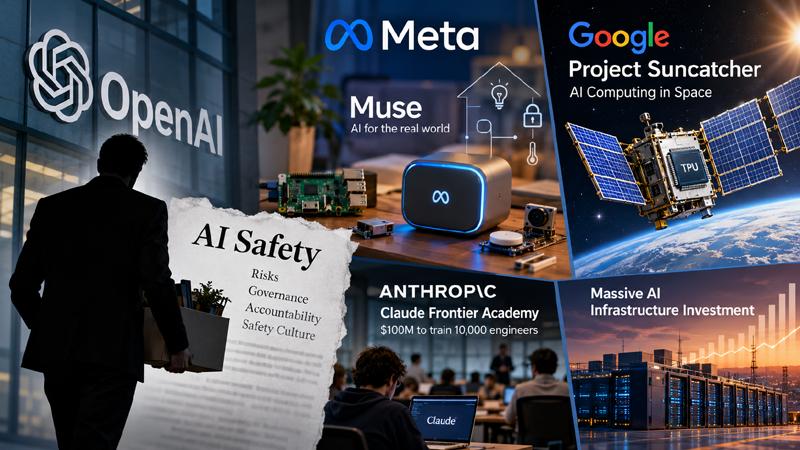
A senior OpenAI safety employee has resigned and publicly criticized the company’s approach to developing increasingly capable AI systems, adding a new and unusually direct warning from inside one of the industry’s leading laboratories. David Robinson, who helped write safety reports accompanying major OpenAI model releases, said the company’s culture had become too focused on rapid development and insufficiently attentive to the risks created by more capable systems. His departure comes amid a broader series of public warnings from current and former AI researchers about whether safety practices are keeping pace with capability gains.
In an essay published by The Atlantic, Robinson argued that frontier AI laboratories should adopt safety practices closer to those used in high-risk industries such as nuclear power and aviation. He said AI development has been characterized by what he described as extreme confidence and perpetual pressure to move quickly, and argued that companies need more redundancy, planning and independent safeguards. These are Robinson’s views, not an independent finding about OpenAI’s overall safety performance, but his previous role in preparing safety documentation gives the criticism particular significance.
The resignation adds to an increasingly visible debate within the AI industry over the balance between rapid deployment and safety. Robinson is one of several researchers and safety specialists who have recently left major AI laboratories and subsequently raised concerns about the direction of frontier-model development. His comments arrive only days after major companies agreed to a voluntary U.S. AI safety framework, making the question of whether internal safeguards are sufficient particularly timely.
Meanwhile, Meta is pushing its Muse AI system beyond the conventional chatbot interface by opening its hardware layer to developers. The company has released the Muse Gadgets project with open-source firmware and a Linux software-development kit, allowing developers to connect Muse to inexpensive hardware such as Raspberry Pi computers and ESP32 boards. Meta demonstrated the concept with Muse Home Link, a small device designed to allow the AI agent to interact with smart-home equipment.
Meta says the initiative is intended to let developers experiment with displays, buttons, sensors and other hardware that can interact with Muse. The company has also produced 5,000 Home Link devices for Muse subscribers. The move is significant because it extends agentic AI from software interfaces into physical environments, where an agent can potentially observe conditions and take actions rather than merely generate text or images. At the same time, giving an autonomous agent control over physical devices introduces additional questions around authorization, reliability and security.
Google is pursuing another unconventional direction for AI infrastructure with Project Suncatcher, which has moved from concept toward an orbital hardware experiment. The company launched a prototype satellite carrying four Tensor Processing Units, or TPUs, in partnership with Planet. The experimental spacecraft is intended to test whether AI computing hardware can operate reliably in orbit, where solar energy is continuously available but heat dissipation, radiation and communications create different engineering constraints from terrestrial data centers.
The experiment is not evidence that commercial AI data centers are about to move into space. Google is still investigating basic engineering questions, including how to manage heat generated by the processors in a vacuum. The company plans additional satellite tests and has described a longer-term concept in which multiple spacecraft could communicate through high-bandwidth optical links. The project nevertheless illustrates how the enormous energy and infrastructure requirements of AI are encouraging companies to investigate alternatives to conventional data-center expansion.
The economic side of the AI build-out is also attracting increasing scrutiny. A new Reuters analysis highlights the extraordinary scale of capital being directed toward AI infrastructure, with projected global data-center spending potentially reaching tens of trillions of dollars over the coming decades. The report notes that economists and financial analysts are questioning whether productivity gains and new AI-driven markets will develop quickly enough to justify the investment being made today.
That tension is visible in the infrastructure strategies of frontier laboratories. Anthropic’s recent financing arrangements, for example, illustrate how model development is becoming closely intertwined with chip suppliers, cloud companies and long-term computing commitments. Its IPO filings disclosed an agreement under which Broadcom could provide up to $42 billion to finance Anthropic’s infrastructure requirements, highlighting the unusual financial structures now emerging around AI compute.
Anthropic is also taking a different approach to the shortage of specialized AI talent. The company announced a $100 million Claude Frontier Academy intended to train 10,000 engineers by the end of 2027, with early participants coming from companies including Accenture, Bain, Capgemini, Deloitte, McKinsey, Morgan Stanley and Novo Nordisk. Anthropic says the program is designed to train engineers to deploy Claude-based systems inside real organizations, reflecting the growing importance of implementation skills alongside model capability.
The latest developments therefore show an AI industry expanding simultaneously in several directions: frontier-model development remains central, but autonomous agents are moving toward physical devices, AI infrastructure is being pushed into unconventional environments, and enormous financial and human resources are being committed to deployment. At the same time, the resignation of a senior OpenAI safety employee demonstrates that questions about whether existing safeguards are adequate remain unresolved. The industry’s next phase is increasingly defined not only by what AI models can do, but by how safely, reliably and economically those capabilities can be deployed.
Sources:
Reuters — OpenAI safety employee quits, says ‘time for trial error is over’ — October 3, 2026. Reuters
The Atlantic — I Quit OpenAI Because Its Culture Is Broken — October 3, 2026. The Atlantic
The Verge — An OpenAI safety employee has quit and is sounding the alarm — October 3, 2026. The Verge
TechCrunch — Meta wants your next gadget to be Muse-infused — October 2, 2026. TechCrunch
The Verge — Meta open sources code to let you make Muse AI gadgets — October 3, 2026. The Verge
NPR — Google launches Project Suncatcher, a step towards AI data centers in space — October 1, 2026. NPR
Reuters — AI’s race to transform the world before the money runs out — October 3, 2026. Reuters
Reuters — Broadcom to lend Anthropic up to $42 billion to lease its chips, filing says — October 1, 2026. Reuters
Anthropic — Anthropic invests $100 million to train 10,000 engineers and tackle the enterprise AI talent gap — October 2, 2026. Anthropic